We recognize science can seem difficult to young scientists, and we hope to raise awareness about people who make it fun and accessible to broader audiences through social media, #SciComm!
--
Meet Brittany, the creative mind behind @bio.britt.shop! As a Biomedical Engineering PhD student at the University of Texas at Austin, Brittany is working to develop gene therapies for cystic fibrosis.
Her Instagram channel is a vibrant mix of science, grad school insights, and her stunning science-inspired art. From tackling cutting-edge research on lipid nanoparticles to sharing tips for staying organized in the lab, Brittany combines her love for science and art in the most inspiring way. Join us as we explore Brittany’s journey, her advice for aspiring scientists, and how she balances research with creative expression!
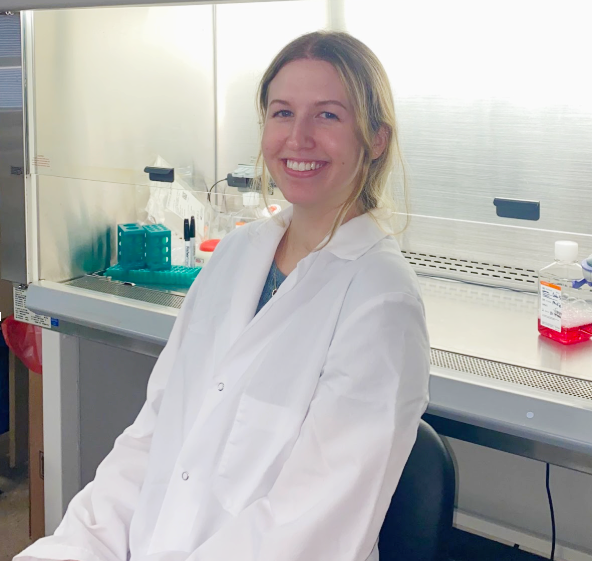
Hi Brittany, we're so happy to have you join our #SciComm blog series - tell us a bit about yourself! What inspired you to pursue a PhD in Biomedical Engineering?
Thank you so much for inviting me! 👋 My name is Brittany, but you may know me as Bio Britt! I’m a biomedical engineering PhD student at the University of Texas at Austin, working toward creating gene therapies for cystic fibrosis.
My Granddad, a civil engineer, inspired me to pursue engineering. Growing up, he helped me with my school science projects, answering my questions enthusiastically and explaining every step. When I got older, he even encouraged me to shadow him at his work!
When I started college, I knew I wanted to apply engineering principles to directly improve people’s quality of life. That’s how I discovered biomedical engineering and decided to study it at the University of South Carolina. While I was there, I joined a research lab during my sophomore year to learn more about the field. Over two years in the lab, I grew more confident in my research abilities, and my graduate student mentor suggested that I consider graduate school. Until that point, I never thought about pursuing a PhD since I didn’t know anyone personally who had gone to graduate school.
After earning my undergraduate degree, I spent a year in the pharmaceutical industry exploring different biomedical engineering applications. But, I couldn’t stop thinking about pursuing a PhD. I felt a strong pull to go back into the academic research setting, leading me to the University of Texas at Austin, where I’m now getting my PhD in Biomedical Engineering.
What’s your current research about?
Overall, my research focuses on creating a stable lipid nanoparticle carrier to deliver RNA to the lungs via inhalation. M nanoparticle degradation during aerosolization, a process that turns liquid into a fine mist for inhalation. Eventually, I will incorporate therapeutic RNA into my lipid nanoparticles to correct the genetic mutation present in cystic fibrosis models.
Cystic fibrosis is a genetic disease that causes thick sticky mucus to accumulate in the lungs, leading to serious infections and massively decreases quality of life. I hope that my work will contribute to an effective treatment for cystic fibrosis!
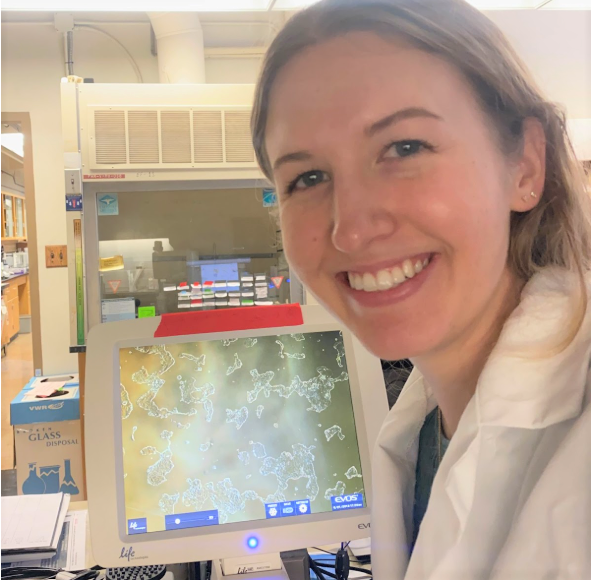
Tell us a bit about your experience so far as a PhD student! What advice would you give aspiring scientists that are considering following a similar path?
I’m currently in my third year of my PhD program. The first two years were a balancing act between taking courses related to my field and conducting lab research. By the end of last spring, I finished my classes and earned my Master of Science in Biomedical Engineering. Since then, I’ve been working full-time on my research projects and on writing a review paper for publication.
I’ve found that determination, hard work, and a little bit of stubbornness are better indicators of successful scientists than undergraduate academic performance.
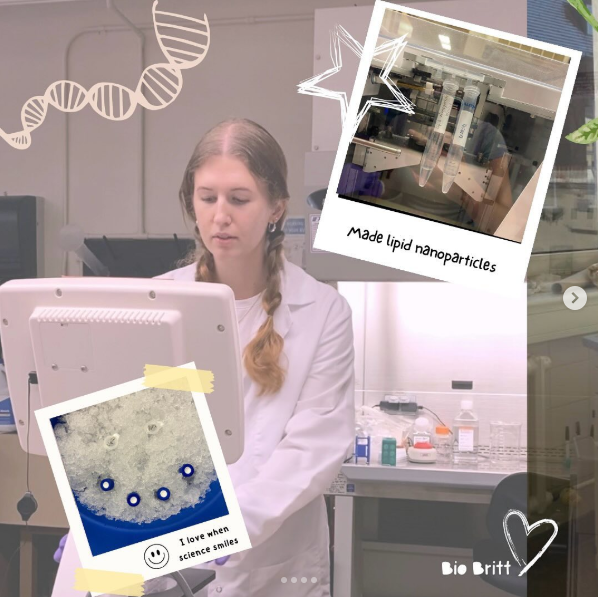
On your Instagram channel, @bio.britt.shop, you share clips of everyday work in the lab and tidbits of knowledge about scientific techniques and lipid nanoparticles. Why did you decide to create this channel?
While my work in science challenges the intellectual side of my brain, it doesn’t often tap into my creative side. That’s why I started Bio Britt Shop—to merge my passion for science with my love for art. A few weeks after creating the account, I began filming clips of myself working in the lab, mainly to give my friends and family insights into where my art ideas came from. Many of them aren’t in the scientific fields, so sharing these videos helped them to understand my day-to-day life and deepened my connection with them. 🤗
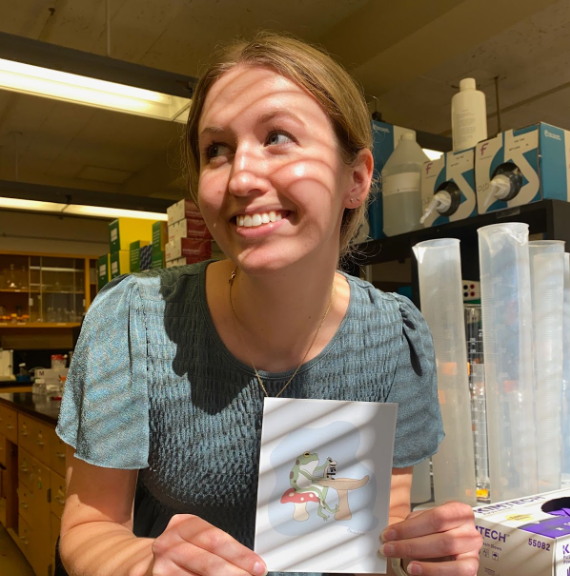
You sometimes share some cute illustrations 🎨 that you made – for example the adorable froggy science postcard! How long does it typically take for you to finish an illustration? Do you have any upcoming illustrations you’re working on?
Thank you so much for your kind words! The time it takes to complete an illustration really depends on the project. For example, the froggy science postcard took about five hours to finish, while smaller sticker designs usually take two to three hours. Balancing my art with the demands of my PhD can be challenging, but I always find my way back to drawing—it’s a great way to unwind and express myself. I’m currently working on some new illustrations inspired by my daily life as a scientist! I’m designing five new stickers, set to release in early 2025, and I can’t wait for you to see it!
You post a lot about staying organized and taking good notes as a graduate student. Do you have any tried and true tips for newbies entering grad school?
I use Google Calendar, Apple Calendar, or Notion because they’re easy to adjust, but a physical planner works just as well. I structure my time by first scheduling commitments involving others, like meetings and mentoring sessions, to align schedules. Then, I plan experiments around these commitments, blocking time for each task (30 minutes to six hours). Any remaining time is reserved for writing review papers or other tasks.
What was something that you didn't expect or something that you wish you knew about before you started your scientific journey?
One thing I didn’t anticipate is just how unique each person’s PhD experience can be. In my program, everyone’s path to their PhD is different, and the experience itself varies significantly depending on the lab you join.
Days in the lab can be long and not every day brings good news. How do you stay positive and motivated when you hit roadblocks in your research? Do you have any tips for mental health?
There are weeks when nothing seems to be working in my experiments, and it’s easy to feel like all that time and effort was wasted. I found that being kinder in the way I speak to myself helps me stay positive and motivated. When an experiment fails, I treat it like a puzzle, working to figure out where the issue arose from. My detailed lab notebook often helps me pinpoint the issue, turning the setback into a learning opportunity. It’s never a waste of time if it helps me grow as a scientist.
--
What's your favorite and least favorite lab technique?
My favorite is gel electrophoresis, it’s so satisfying to make the gel. My least favorite is the in vitro transcription process to turn DNA into mRNA. My protocol for this typically takes 10-12 hours.
Do you have a music playlist to “chill and do research to” in the lab? If not, what genres or songs would you put in it?
Oh yeah, I have multiple playlists I rotate between! For computer work, I enjoy soft jazz or cozy bookstore ambience on YouTube. 🎶 During experiments, I shuffle through my library of alternative and R&B songs.
What do you like to do to relax after a long day?
I love curling up with a good fiction novel on my couch or working on one of many art projects. 📖 Lately, I’ve been gravitating toward landscape painting or creating homemade gifts for my friends and family.
If you could say one thing to your past self from 5 years ago, what would it be?
You can do anything you set your mind to. Keep going! Your hard work will pay off!
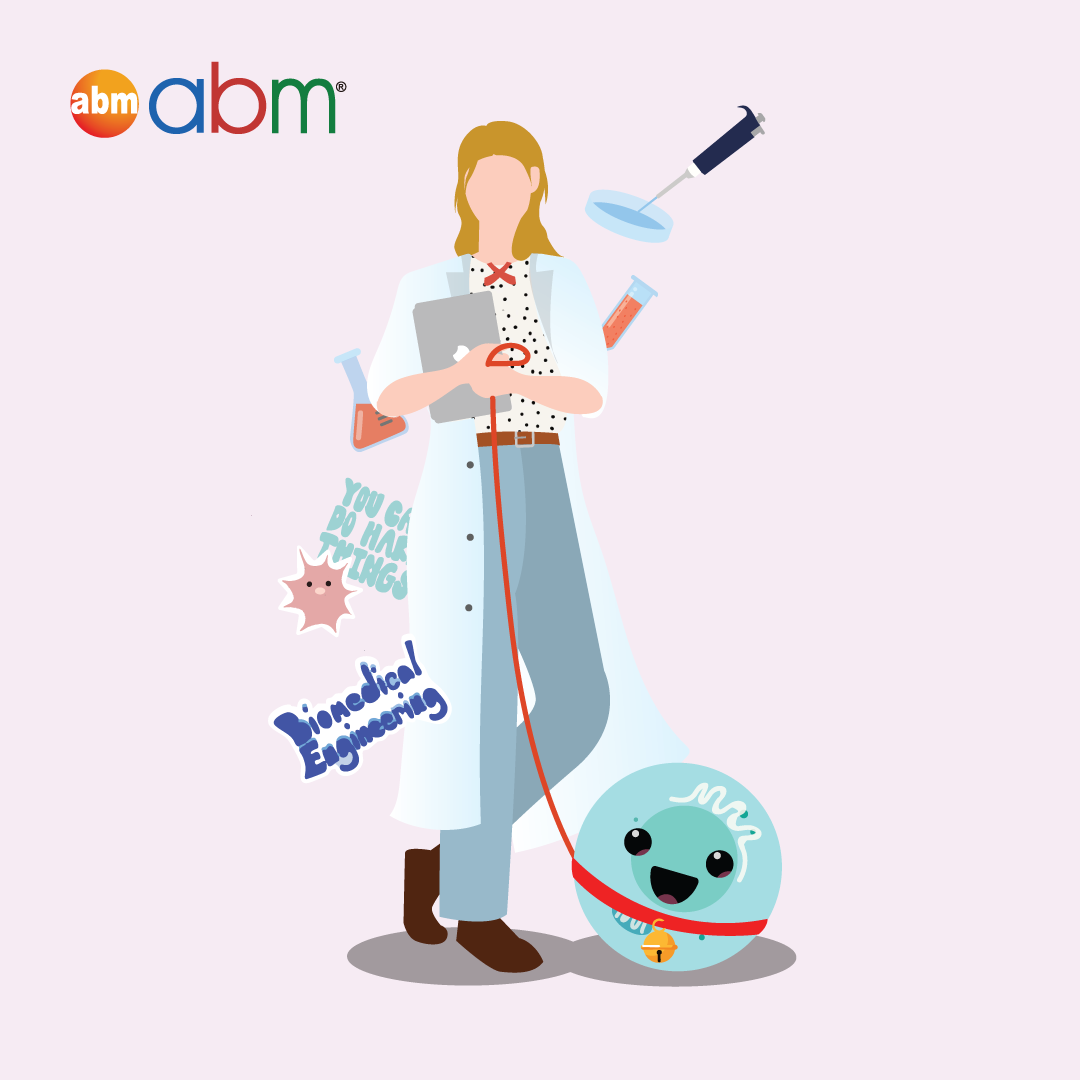
You know you’re a biomedical engineer when…
you view your cells as little lab pets :)
Thank you, Brittany, for sharing your inspiring journey and insights with us! Your passion for science and creativity is truly motivating. We can’t wait to see all the incredible things you’ll accomplish in the future! Follow Brittany’s journey and explore her science-inspired art on Instagram at @bio.britt.shop. If you'd like to be featured, message us on our instagram channel, @abm_good!
Educational resources for life scientists and interviews with scientists/science comunicators in the field.
For more in-depth articles, check out our knowledge base, which covers topics such as CRISPR, Next Generation Sequencing, PCR, Cell Culture, and more.
Blog managed by Applied Biological Materials (abm).
