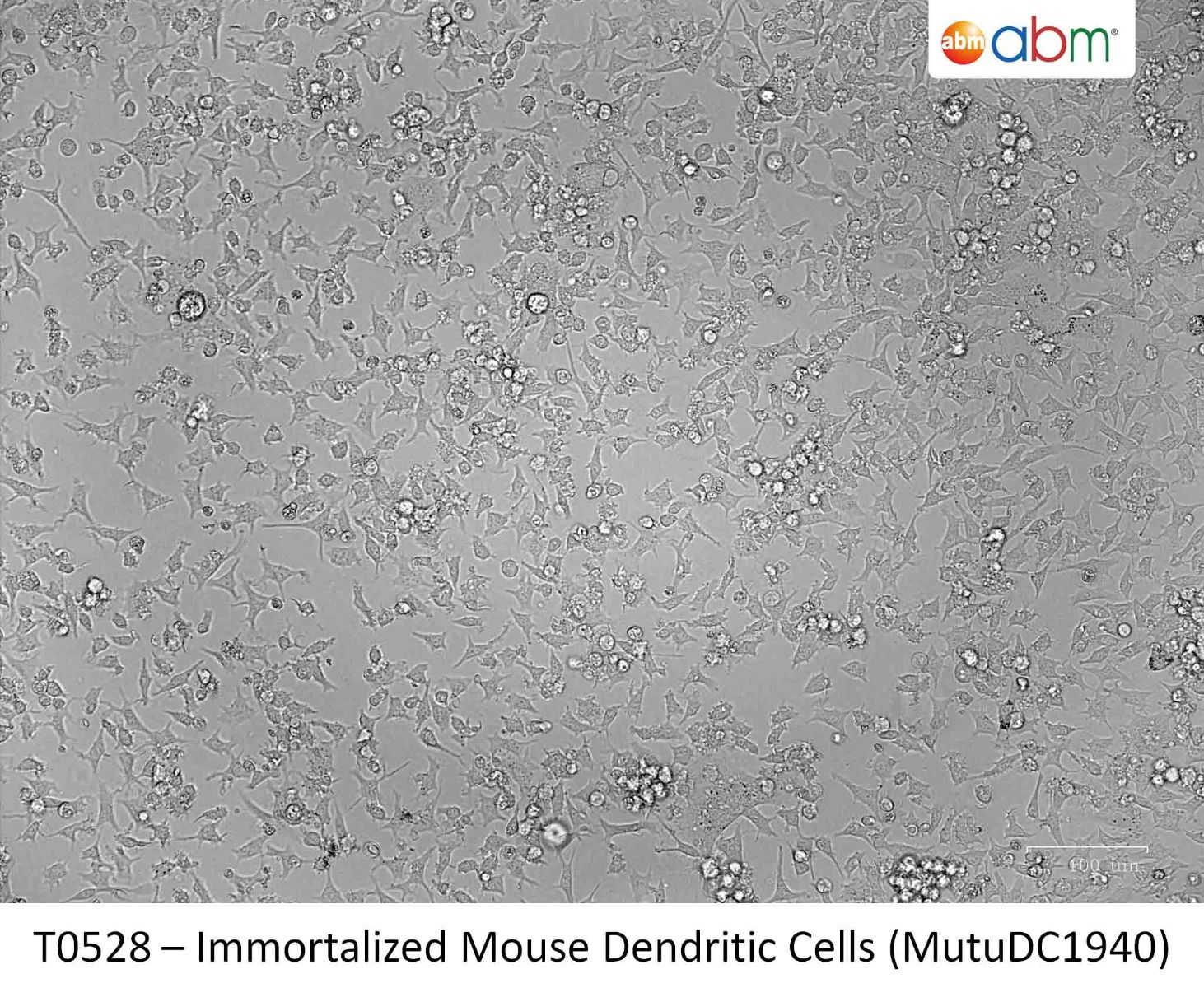
|
|
|||||||||||||
Expression Data
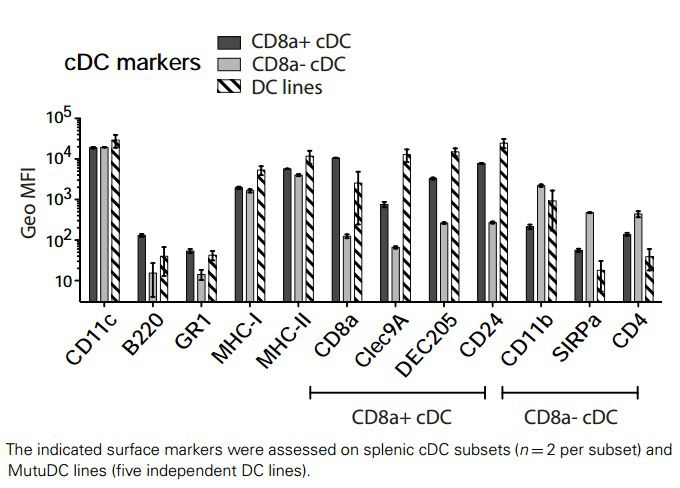 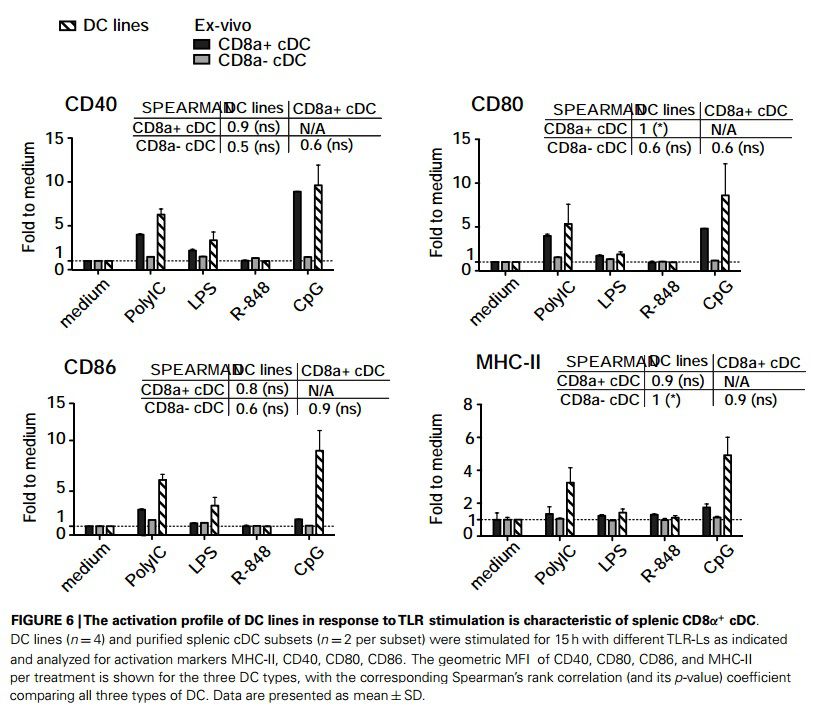  |
Specifications
• Source Organ: Spleen
• Immortalization Method: Isolated from C57BL/6 transgenic mice carrying SV40 Large T oncogene
• Markers: CD11c, CD24, MHC-II+, DEC205, Clec9A, B220, CD11b, IRF4, IRF8, CD4
• Growth Properties: Adherent
• Cell Morphology: Small aggregates
• Species description: Mouse (M. musculus); CD11c:SV40LgT-transgenic C57BL/6 mice
Propagation
• Seeding Density: 20,000 – 60,000 cells/cm2. Recommended split ratio: no greater than 1:3.
• Population Doubling Time: 45 - 55 hours
• Propagation Requirements:
The base medium for this cell line is IMDM (1x) + Glutamax™ (Gibco Ref: 31980-030). To make the complete growth medium, add the following components to the base medium: heat-inactivated fetal bovine serum (TM999) to a final concentration of 10%, 1% of 7.5% Sodium Bicarbonate Solution, 50 µM β-mercaptoethanol, HEPES to a final concentration of 10 mM, and Pen./Strep. Solution (G255) to a final concentration of 1%. Filter the complete media at 0.22µm before use.
Change the complete media every 2-3 days. Do not let media colour change to yellow. Carbon dioxide (CO2): 5%, Temperature: 37.0°C.
To heat-inactivate FBS:
1. Let the FBS bottle completely thaw overnight at 4°C.
2. Leave the FBS bottle in water bath for 30 minutes at 56°C.
3. Heat-inactivated FBS can be stored at -20°C for long term. Avoid frequent freeze-thaw cycling.
To thaw T0528:
1. Thaw the vial in 37°C water bath until there is no more than a small cube of ice.
2. Transfer the cells to a 15ml tube containing 5ml of pre-warmed complete media.
3. Centrifuge the cells at 290xg for 5 minutes.
4. Carefully discard supernatant without disturbing the cell pellet and gently resuspend the cells in 1ml of complete media by lightly pipetting up and down.
5. Seed the cells at 20,000 - 60,000 cells/cm2.
To subculture T0528:
1. It is recommended to subculture when cells are at 70-90% confluency.
2. Aspirate old media. Some cells in suspension are still viable cells. Alternatively, the supernatant containing the suspended cells can also be collected and centrifuged (Skip to Step 6 in protocol).
3. Add 1:1 ratio of 1X sterile PBS and 0.25% Trypsin-EDTA (TM051).
4. Incubate cells at room temperature for 3-5 minutes and agitate the culture vessel until 90% of the cells have detached.
5. Immediately neutralize the trypsin by adding complete media equal to the volume of trypsin + PBS added.
6. Collect the cells and centrifuge at 290xg for 5 minutes.
7. Discard the supernatant and gently resuspend the cells in complete media by lightly pipetting up and down.
8. Recommended split ratio is no more than 1:3.
Stimulation can be performed using PolyIC (5 µg/ml), CpG (2 mM) or LPS (5 µg/ml). These cells are especially sensitive to FBS requirement, thus, it is advised to use the same batch for culturing cells that show best result in supporting their culture. We also recommend the addition of extra 1% HEPES to the complete media to encourage propagation of the cells.
To freeze T0528:
Recommended freezing medium: Complete growth medium with heat-inactivated FBS to a final concentration of 50% and 5% DMSO. Storage temperature: Liquid nitrogen vapour phase.
Quality Control
1) Direct antigen presentation and cross-antigen presentation were evaluated by the MHC-I (SIINFEKL/OT-I ) and MHC-II (OVA323-339/OT-II) restricted systems; 3) proteome profile and surface markers assessed by RT-PCR; RT-PCR; 3) IL-12 cytokine secretion analyzed using ELISA ; 4) Response to PAMP stimulation evaluated by functional assays
Disclaimer
1. For for-profit organizations and corporations, please contact quotes@abmgood.com for pricing of this item.
2. Sale of this item is subjected to the completion of a Material Transfer Agreement (MTA) by the purchasing individual/institution for each order. If you have any questions regarding this, please contact us at technical@abmgood.com.
3. All test parameters provided in the CoA are conducted using abm's standardized culture system and procedures. The stated values may vary under the end-user's culture conditions. Please verify that the product is suitable for your studies by referencing published papers or ordering RNA (0.5 μg, Cat.# C207, $450.00) or cell lysate (100 μg, Cat.# C206, $600.00) to perform preliminary experiments, or alternatively use our Gene Expression Assay Service (Cat# C138). All sales are final.
4. We recommend live cell shipments for ease of cell transfer and this option can be requested at the time of ordering. Please note that the end-user will need to evaluate the feasibility of live cell shipment by taking into account the final destination's temperature variation and its geographical location. In addition, we thoroughly test our cell lines for freeze-thaw recovery. If frozen cells were received and not recovered in your lab under the exact, specified conditions (using recommended culture vessel, media, additional supplements, and atmospheric conditions), a live cell replacement is possible at a cost (plus shipping).
5. All of abm's cell biology products are for research use ONLY and NOT for therapeutic/diagnostic applications. abm is not liable for any repercussions arising from the use of its cell biology product(s) in therapeutic/diagnostic application(s). Please contact a technical service representative for more information.
6. abm makes no warranties or representations as to the accuracy of the information on this site. Citations from literature and provided for informational purposes only. abm does not warrant that such information has been shown to be accurate.
7. abm warrants that cell lines shall be viable upon initiation of culture for a period of thirty (30) days after shipment and that they shall meet the specifications on the applicable abm Material Product Information sheet, certificate of analysis, and/or catalog description. Such thirty (30) day period is referred to herein as the "Warranty Period."
Depositor
University of Lausanne (PACTT)
References
1. Fuertes Marraco, SA et al. "Novel murine dendritic cell lines: a powerful auxiliary tool for dendritic cell research" Front Immunol 3:331 (2012). DOI: 10.3389/fimmu.2012.00331.
2. Duval, A et al. "Large T Antigen-Specific Cytotoxic T Cells Protect Against Dendritic Cell Tumors through Perforin-Mediated Mechanisms Independent of CD4 T Cell Help" Front Immunol 5:338 (2014). DOI: 10.3389/fimmu.2014.00338.
3. Marraco, SA et al. "Novel Murine Dendritic Cell Lines: A Powerful Auxiliary Tool for Dendritic Cell Research" Front Immunol 3:331 (2012). DOI: 10.3389/fimmu.2012.00331.
4. Fuertes Marraco , SA et al. "Novel murine dendritic cell lines: a powerful auxiliary tool for dendritic cell research" Front Immunol. 3:331 (2012). PubMed: 23162549.
5. Joshi, PS et al. "Characterization of immortalized human mammary epithelial cell line HMEC 2.6" Tumour Biol. 39(10):1010428317724283 (2017). DOI: 10.1177/1010428317724283. PubMed: 29022488.
|
World's Largest Collection of Unique Cell Lines |
|
|
|
|
|
|
Why Use Immortalized Cell Lines? |
|
|
|
|
|
Why Choose abm? |
|
|
|
Testimonials |
|
 |
I really like to order from abm as the ordering process is fairly straight forward and the documentation provided, especially with the cell lines, is very well detailed and complete.
- Nancy Petitclerc, Immuni T |
|
Request A Free Copy of Our Cell Line Catalog |
 |