In the third addition to our Vectors and Viruses Spotlight Series, we'll introduce you to the Adeno-associated virus (AAV), a small but powerful viral delivery system. An up-and-coming hero of the gene therapy world, AAVs are being used to deliver gene therapies for a wide range of diseases - from heart failure to retinal dystrophy - accounting for almost 8% of all vectors used in gene therapy clinical trials. Learn the advantages of choosing to use AAV in your experiments.
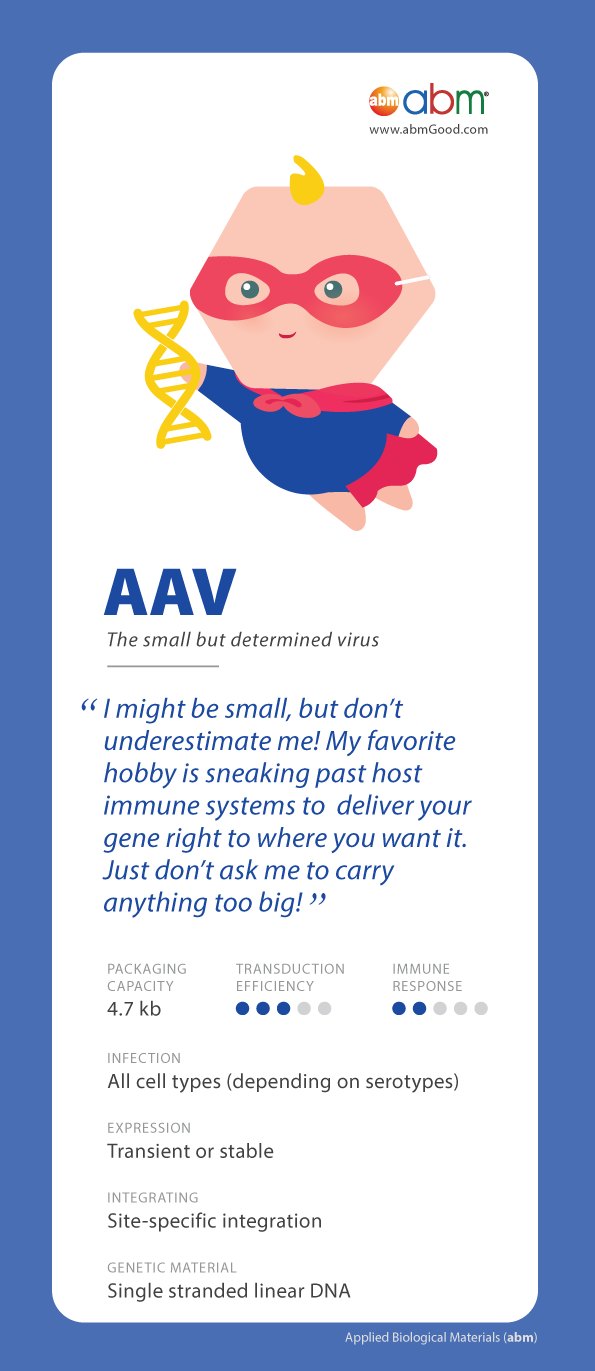
"Hi, I’m Ava! I might be small, but don’t underestimate me! My favorite hobby is sneaking past host immune systems to deliver your gene right to where you want it. Just don’t ask me to carry anything too big!"
The Adeno-Associated Virus (AAV) is a promising candidate for virus-based gene therapy. Recombinant AAV forms episomal circular concatemers in the nucleus of cells. This episome does not integrate into the host genome, so as the cells replicate, the DNA becomes diluted. This will eventually result in the loss of transgene expression, with the rate of loss dependent on the replication rate of the transduced cell. However, the fact that AAV doesn’t integrate means that there is no risk of insertional mutagenesis, which can lead to oncogenesis. Additionally, of the commonly used viral vectors, AAV elicits the lowest immune response. For these reasons, AAV is often used for therapeutic applications and in vivo experiments.
Many different serotypes of AAV have been discovered. These serotypes have different cell surface receptors, which leads to a different tropism for each virus variant. This natural variation can be exploited in gene therapy; one can choose to package a recombinant AAV as a serotype that preferentially infects the cell type(s) of interest. Learn more about the tropism of different AAV serotypes.
A drawback to using AAV is its small packaging size. The length of the expression cassette should not exceed 4.7 kb. Anything above this size leads to a considerable reduction in viral yields and/or truncations of the transgene. Another disadvantage of AAV is that some cell types may require a high Multiplicity of Infection (MOI) to achieve transduction.
Looking to work with Adeno-associated Viruses (AAV)? Have a look at our selection.
abm offers the following genome-wide AAV collections
Other Adeno-associated Virus (AAV) products and services we offer include:
Don't know which viral vector to choose?
You know you want to express a gene, but when it comes time to choose an expression vector, your choices can seem overwhelming. Do you go viral or non-viral? Which virus should you use? Or maybe it's not a protein you need to express, but an RNA species?
Try using our Vector Selection Tool. Cut through the fog with this Vector Selection Tool. Simple, clear recommendations for every application.
Educational resources for life scientists and interviews with scientists/science comunicators in the field.
For more in-depth articles, check out our knowledge base, which covers topics such as CRISPR, Next Generation Sequencing, PCR, Cell Culture, and more.
Blog managed by Applied Biological Materials (abm).
